Day 1, Dec. 17, 2017, PM session, Pune, India.
Prashant began our afternoon session by setting expectations and asking us to recognize the nature of his work. “We have to be on that plane where we are doing together, not that I am teaching. I will be triggering the thought process within you that leads to classical yoga.” It is when we are relaxed and at home that we can truly come to know the Self, for there can be an honest inquiry then. He suggested that isolation is the best environment for real study, and that is why he has not traveled to teach anywhere.
The invocation “establishes the compatibility with the endeavor” that is to follow. The main principal in yoga and in the Yoga Sutras is one of internalization. Knowing this prepares us for the learning that is to come. Prashant systematically prepares us for the invocation. He says little about the physical posture, but will reference that you should sit with noble intentions. The focus then turns toward the exhalation, leading towards deeper and deeper exhalations. He asked us to exhale from the pelvic floor, in the eyes, from the brain. I remembered Guruji saying that the exhalation is an act of surrendering one’s finite into the infinite. How Prashant begins with the body, focuses on patterns of exhalation to reinforce the letting go, and then directs the exhalations into various spheres that further reinforces this internalization. Ultimately we are asked to abide within the heart. Invocation….
Many of us have “tagged” Prashant by saying that he works with the breath. But Guruji taught breathing, he explained. When he gave a demonstration it was a feast for the eyes, it was a super human feat. And the exhalation was a major part of it. “He was the first to introduce using the breath as a prop.” The breath can be strong medicine to push you out of your comfort zone in many ways. “Did Guruji not dig you out of your ability?” Did he ever say “do as much as you can”? Guruji taught with intensity. He may have been addressing particulars such as to stretch the fingers, upper arms, and the four corners of the elbow; and the only way you could maintain this pose was by using your breath. Imagine that you were demonstrating a pose in front of him, you would not want to come out of the pose. It is the breath that helps you stay longer. The breath can be used to exercise, to sustain or maintain a pose; it can also be used as a tool to investigate, to direct and to condition the body/mind. So we should not think that Prashant is bringing something new here, this was his point.
“Similarly, postures should not be merely done, like mechanical breathing. Postures should be used. Suppose you do a great and perfect pose, what is next? You come down and out of the pose, it is finished. How anti-climactic! Rather, the postures are to be used to address any condition that afflicts us. In the back of Light on Yoga there are many sequences for various conditions. For example, Sirsasana and Sarvangasana are frequently recommended. The application would be different if you were working with a student suffering from constipation than from someone with diarrhea. How can the same pose be used in diametrically dissimilar conditions? The pose must serve a purpose and not be merely for display.”
“What is the difference between the breath and breathing? Breath is a quantity and breathing is a process. When you endeavor to go further, you need more quantity. For every state of mind there is a corresponding breathing process. When we say to students to breathe normally, do we mean volume or the process? There are countless breathing practices.” This reminds me of when I first questioned Prashant many years ago. Chris Stein and I interviewed Prashant about how to begin to introduce his work into our teaching. So funny to imagine asking him anything like that now, for that is diametrically opposed to his current message. We must each find out our own way. However, Prashant was very gracious and he said to begin by working with the exhalation in various ways in the postures. My practice has changed considerably since that conversation.
“Let me watch how I breathe in different conditions to see if this breathing patter is compatible?” He then referenced the sutras. Would the process of breathing be different for: Sthira sukham (firm, steady and happy) II.46? For Prayatna (persevering effort) II.47. For Saithilyananta (relax into the infinite being) II.47? “Read”, he said, “how the breath is used to do these different modes, what is breathing mode in each? For every Chitta Bhumi (qualities of mind) there is a state of breath.” I realized that I have been breathing on a very surface survival level. While I know that slowing my breath down is good when I am upset, I have not watched each minute of each day to understand the potentials in the breath. Nor have I penetrated deep enough into the nature of the breath in the way that I have with my asana practice. Yet the breath is more vital, more profound, more complex. Prashant suggested that these lessons should learned spontaneously and that “instructions become obstructions.”
We only did a few asanas, but we did them intently. We practiced Sirsasana in the mode of exercise, lifting the legs, shoulders, etc. And then we repeated the pose but for a state of tranquility.
We had been sitting for almost two hours so a standing pose was most welcome. Trikonasana from the point of the back foot, he said, for stability, and watch coming out of the pose; the same composure would remain. We came out of the pose really slowly so as to observe any changes in the breath, mind and body. We next did Adho Mukha Svanasana and stepped into Utthita Trikonasana. This was completely different, of course? Finally we practiced Bharadvajasana followed by Utthita Trikonasana. “Essential yoga cannot be taught,” he said, “it has to be learned.” While we were practicing Utthita Trikonasana, we approached it through three different gates, and the experience was completely different. The practice was more about the discovery than the doing of it.
Guurji never taught Geeta and Prashant directly, he explained. Rather, they had to “see, to analyze, to recall and react, to deliberate and reflect and then try to comprehend.”
The evening session looked like it was going to go over three hours. Someone from the venue came and told Prashant that it was time to leave. He is so full of inspiration that he could have continued indefinitely, but we certainly were ready to digest this amazing meal of thought, breath, and breathing.
 ant to post, but I think you would all gag and not complete the blog! So I will extend the posts past the six days of inspiration..
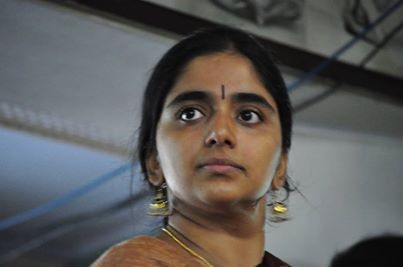 Abhijata is the young lioness taking charge of her cubs (us) now that her grandfather is no longer here to teach her and her aunt (Geetaji) rarely teaches. Abhi began her apprenticeship over fifteen years ago, when she was sixteen. She was never far from her grandfather’s eyes, and practiced daily with him. I remember Guruji looking into his granddaughter’s big dark eyes and asking impossibly difficult questions about an asana or about life. She would look back at him, innocent, knowing that he was about to spin his wonderful web of teachings. I am privileged to see this next generation begin to fill the role of “revered master”. Abhi has a master’s degree and two children of her own. She began traveling with Geetaji and Guruji as they presented at conferences in the US, China, Russia and Europe. She could see how different cultures interacted with her teachers. In some cases there was a language issue. She is now a perfect ambassador between the legacy that she has inherited and the 21st century!
 Dec. 15, 2017, Govinda’s Gardens, next to the Ragwada Hotel, near Baner road, Pune, India. 4:00 onwards, dinner at 7:30.
 Totality: that is what everyone called it. The magnificent eclipse of August 21, 2017. The hype was exhilarating.
 Every day I find myself on my yoga mat. During these vacation weeks I often begin with Savasana. Some days I pursue an asana, or I explore releasing or stimulating a part of my body. Some days I do what Geetaji calls a “donkey practice”, I go through the paces. But now, on some special days, after any asana where I feel either my heart rate increase (backbends) or a flush of endorphins (forward bends), I stop and feel. How is my breath, where does my breath touch, and the heartbeat, how are my sensations changing with each breath, and between breaths. I tune in to the “not-doing” to feel the transfiguring power of each asana and sometimes, the integration and harmony within. Perhaps this is a union of sun and moon, the doing and “not-doing”. Another step in a long journey.
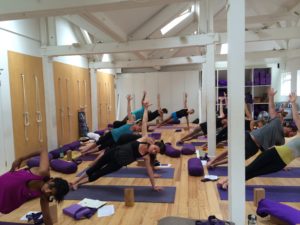 It’s always gratifying to be part of building a community. Tri-Yoga has been my home in London for the last three years, and I look forward to seeing everyone again. This year’s workshops touch on themes that impact us all in very direct ways.
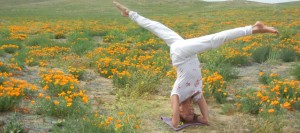 Introduction to Iyengar Yoga for Teachers