
Please sit tight, this is worth the next fifteen minutes of your time. It was worth it for me to meditate and write it.
Starlight – daylight – candlelight – moonlight – twilight – backlight –Shree B.K.S. Iyengar wrote Light on Yoga, Light on Pranayama, Light on Life and Light on the Yoga Sutras. Our studies, curiosity, direct experience and wonder are invitations beckoning for insight. The word “guru” means one who removes the darkness. It is through our efforts that we become our own guiding light, if only we have the faith and energy to practice. And yet, as Leonard Cohen, in his album Anthem noted “There is a crack in everything, that’s how the light gets in”.
Life is full of the unexpected. This poem highlights the nature of the inner quest. Read the stanza on fugitive light several times, as well as the last paragraph. The last lines here give the essence of a contemplative practice.
LIGHT – John O’Donohue
Light cannot see inside things. / That is what the dark is for / Minding the interior, / Nurturing the draw of growth / Through places where death / In its own way turns into life.
In the glare of neon times, / Let our eyes not be worn / By surfaces that shine / With hunger made attractive.
That our thought may be true light, / Finding their way into words / Which have the weight of shadow / To hold the layers of truth.
That we never place our trust / In minds claimed by empty light, / Where one-sided certainties / Are driven by false desire.
When we look into the heart, / May our eyes have the kindness / And reverence of candlelight.
That the searching of our minds / Be equal to the oblique / Crevices and corners where / The mystery continues to dwell, / Glimmering in fugitive light.
When we are confined inside / The dark house of suffering / That moonlight might find a window.
When we become false and lost / That the severe noon-light / Would cast our shadow clear.
When we love, that dawn-light / Would lighten our feet / Upon the waters.
As we grow old, that twilight / Would illuminate treasure / In the fields of memory.
And when we come to search for God, / Let us first be robed in night, / Put on the mind of morning / To feel the rush of light / Spread slowly inside / The color and stillness / Of a found world.
my fancies…
And when we come to search for God,
Listening for the ineffable, the mystery, the sacred, we have few words, humble
Let us first be robed in night
Robed in night, eyes not seeing, at rest, cloaked in darkness
Put on the mind of morning
Morning is fresh. Thich Nat Hanh says, in Silence:
Waking up this morning I smile. / Twenty-four brand-new hours are before me. / I vow to live them deeply
To feel the rush of light / Spread slowly inside
This is deep relaxation, when the periphery nerves soften and warmth spreads through the body. Looking into a babies eyes might illicit this joy, it is pure, simple, direct.
The color and stillness / Of a found world.
Books, words, teachers are belittled compared with direct experience. Even as the Yoga Sutras refer to the transition from one-pointed attention to an all pervasive awareness, only meditation in whatever form enables this leap from stillness to silence. This found world will disappear as soon as we emerge back into the “severe noon-light”, the neon times” or “empty light” referred to in earlier stanzas.
I love these closing lines, the color and stillness of a found world.
May the year ahead bring us more light! GOOD light!
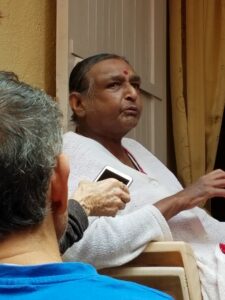 Today, December 7, I read that if Guruji is the soul of Iyengar yoga, then Geetaji is the heart.
 Leadership.. thoughts on receiving an award where I have done only what the universe asked of me. The cliché “follow your bliss” sounds hollow, except that it is the only way to feel like I have lived fully, unapologetically; as if stumbling through to the next opportunity/challenge. Made popular by Frank Sinatra, the lyrics to “I did it my way”, whether in French, by Elvis, or Franky, this song accompanied me when I divorced my first husband to follow a future in yoga. It was 1982.
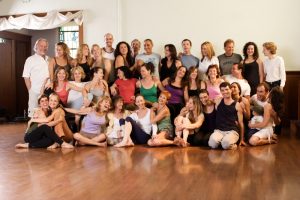
 The training intensive was fabulous! One unexpected boon to the “commercialization” of yoga, is that, with YogaWorks, there was a professional business behind the teacher trainings. They would handle marketing, formatting manuals, registration, all of the business issues that support an effective program.
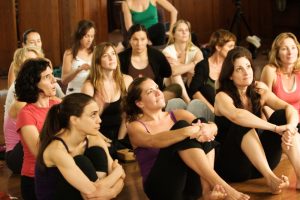 Teachers from New York joined us. You may recognize Natasha Rizopoulos, Julie Kleinman-Woods, Jenny Arthur, James Brown, Jasmine Lieb, Malachi Melville, Vinnie Marino, John Gaydos, Birgitte Kristen, Sonya Cottle, Thomas Taubman, Rasha!, Casey Coda, Russ Pfieffer (shout out, check out his FB group Psychology of Anatomy), Jessica Smith, Amy LaFond,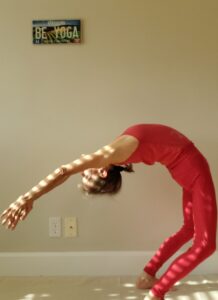

 teaching for over forty years. He has studied Sanskrit and Indian philosophy at Oxford University and taught yoga in Oxford for more than 20 years. Kofi is one of very few teachers who seamlessly weaves wisdom teachings in a practical and contemporary way through out his classes.


 a culture. What makes culture, or a culture? The dictionary says: “the customs, arts, social institutions, and achievements of a particular nation, people, or other social group”. Who is to say that birds do not have customs? Or that the relationship between trees, bugs, birds, and seeds is not a social institution? I love the idea of the culture of nature. Perhaps if we study the natural world we may find an organic rhythm that flows, ebbs, rises and subsides. Of course, taking a bird’s eye view of history we will see these tides of change rise and fall. Ours is but a breath in the life of the history of our people. Yet every breath counts!
 What do we do when confronted with suffering, when we are disillusioned with life, when someone betrays or harms us, when the unimaginable happens? Losing our footing – as we say- and slipping into despair, frustration, anger or grief is a natural reaction when life throws us a curve ball. We tend to think of this as a personal phenomenon, but we are experiencing cultural and global grief on a scale not seen in nearly a century.