
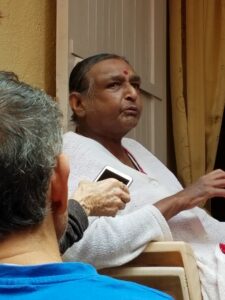
 Today, December 7, I read that if Guruji is the soul of Iyengar yoga, then Geetaji is the heart.
Forty years ago, this coming January, I made my first of what would become many pilgrimages to Pune, India. The year was 1986. Upon Guruji’s alleged retirement from active teaching in 1984, Geeta Iyengar had assumed that role for us eager Western students.
Geeta was Iyengar’s first of five daughters. As the first born, upon the death of her mother in 1973, she oversaw the household, raised her sisters and brother, and continued her intensive practices with her father. Born frail and with one kidney, her father challenged her to heal through practice rather than be subjected to a life of medication. Like her father, her health issues invoked from her an empathetic sensitivity to the struggles of every person, but women in particular. Her rigorous studies included Ayurveda, which she incorporated into her writings and presentations. For me, Geeta was my first introduction to how an understanding of Ayurveda could enhance my practice.
Geeta wrote YOGA, A GEM FOR WOMEN in 2002. This was the era when yoga was fast becoming the health path du jour, and young women flocked to the mat. Geeta explained that, in yoga, we respect nature, its systemic balance and cycles. As a young woman, then, I wanted to know for myself. I practiced a ten minutes Sirsasana on the second day of my cycle. The flow stopped, and did not begin again until the following month. There have been studies (I will research if anyone needs verification) of athletes who took a few day off of training during their monthly cycle and those who trained throughout the month. Statistically, those who rested fared better in competition.
Geeta also advised on how to address pregnancy, and menopause. While she was writing A Gem, menopause was rarely spoken of. In nature, giving birth is associated with survival of the species. And in the act of procreation women were often used for the mere pleasure of men (historically, before the Women’s movement). Perhaps the “older” woman, who would no longer function in these ways, were less coveted and hence marginalized. Even now, it is often hard for older women to be seen and heard. In indigenous populations, the older woman was the elder, the wise one. Geeta recognized the emotional and physical changes that women go through in this stage and addressed them.
Women are the backbone of society, says the Bhagavad Gita. Geeta was the backbone of the family and the teacher training programs. She wrote the Preliminary Course and Intermediate Course books to build upon the material in Light on Yoga. She supervised the networking and growth of Teacher’s Training and the assessment process worldwide.
A remarkable woman indeed. I was lucky enough to be present for Guruji’s 80th birthday. I was held at the Institute. Geeta took the week off; we did not see her until the final day of celebrations. When she approached the microphone, she walked slowly. I was spellbound as she began to apologize for her lack, as she explained, of proficiency in her asana and practice. She told us that, in preparation for the festivities, her duties had kept her in the kitchen and that she was really tired. What was unsaid, but loud enough for me to hear, was that her dedication to building and supported the teacher training programs worldwide, her regular teachings in medical and daily classes, her travel to help promote local communities and to spread Iyengar yoga had worn her down. Geeta is my heroine.